
 ChatGPT
AI Mode
ChatGPT
AI Mode
 Claude
Perplexity
Grok
Claude
Perplexity
Grok
Last Updated on August 27, 2026 by Henry

Table of Contents
Rankings still matter today. But they no longer give a complete picture of your brand visibility. A brand may rank well because of a few keywords. However, it can remain invisible across the broader search ecosystem.
On the other hand, another brand can earn citations from trusted sites, appear in AI-generated answers, and dominate SERP features. But you won’t even see it on the first page on Google.
That’s why, these days, it’s important to measure search visibility as a brand-level presence, not just a collection of keyword rankings. Let’s figure out what you should measure exactly and how it works.
What Is Brand Search Visibility?
Brand search visibility is how often your products, content, brand, website, and expertise appear when people search for topics related to your business.
But it goes beyond keyword rankings. Search visibility also includes:
- Branded and non-branded searches,
- Backlinks and referring domains,
- SERP features,
- AI-generated answers and AI Overviews,
- Clicks and engagement,
- Brand mentions and citations.
It isn’t only important to rank higher these days. You should become more consistently discoverable when your target audience searches for brands, products, solutions, or information in your industry. That’s why, to understand how well you perform, you need to track your brand visibility, share of search, CTR, AI citations, and so on.
Why Rankings Alone Are No Longer Enough?
A ranking report can show you that a certain page moved from #9 to position #3. But it doesn’t mean that this improvement led to meaningful business results. That’s because search results are much more complex. A single SERP can include shopping results, ads, maps, news, and AI-generated answers. So, the position doesn’t guarantee visibility.
Besides, if you want to be visible in AI search, rankings might not be that representative. Research reveals a 62% overlap between Google rankings and ChatGPT answers. That shows that SEO success doesn’t equal visibility in AI search results. So, even if you dominate Google’s first page, it doesn’t mean that you will be automatically mentioned in ChatGPT or other LLMs.
How to Measure Brand Visibility?
Let’s take a look at the exact strategies you can use to measure your brand visibility:
Track Share of Search Visibility
Share of search is how much of the search demand your brand gets when compared to other brands in your industry. It places your visibility into context instead of only looking at your traffic and rankings in isolation.
To measure it properly, create a keyword set around your core topics, problems, products, services, and categories. Then, you can track your brand’s visibility across this set.
Use metrics like:
- Visibility by search intent,
- Visibility by category of keyword,
- Visibility compared to other brands in your niche,
- Visibility trends over time.
This way, you can get a more strategic view of your competitive search presence.
Measure Brand Mentions and Citations
Brand mentions are instances when someone references your business, product, or company. Citations most often refer to you being mentioned as a source for a particular data point, expert quote, statistics, example, case study, etc.
Why is it essential to measure brand mentions and citations?
With rankings, you can understand how well your website performs in Google search (or another search engine). But brand mentions and citations help you understand how visible your business is and whether others are willing to mention and reference it.
Look for specific places where your brand gets mentions:
- News websites,
- Industry publications,
- Blogs and podcasts,
- Reviews and expert roundups,
- Social platforms and communities.
It is vital to consider who mentioned you, in what context, where they mentioned you, and whether or not your competitors are referenced more frequently.
Track Backlink Quality
Backlinks are links from another site to your site. Not all of them contribute equally to brand search visibility. So, measuring only the number of them is not enough.
It is vital to also track backlink quality. That’s because even a smaller number of links from trusted and relevant sites can be much more valuable compared to hundreds of irrelevant and low-quality links.
When analyzing your backlinks, consider looking at such factors as:
- Topical authority,
- Editorial placement,
- Geographic relevance,
- Brand mentions within links,
- Competitor backlink gaps,
- Number of relevant referring domains.
Similar to brand mentions and citations, when high-quality websites naturally link to you, it means that your brand is visible and trustworthy.
Monitor Your AI Visibility
AI visibility is how prominently and how often your brand appears in AI-generated answers and recommendations. To understand how well you perform in AI search, you have to track whether AI systems cite, describe, recommend, or mention your brand when users ask relevant questions.
It’s nearly impossible to measure it 100% accurately because there is no relatively stable ranking system like in traditional search. And answers in AI tools vary a lot from prompt to prompt. However, it is still worth doing because:
- AI answers can create visibility without a traditional click.
- It shows whether AI associates your business with your niche.
- AI search popularity is growing, so it’s important to show up in AI answers.
Separate Branded and Non-Branded Visibility
Separate your visibility data into:
- Branded searches. These are searches that contain your brand, company, or product name.
- Non-branded searches. These are searches that describe topics, categories, products, services, or issues without mentioning your brand.
The separation distinguishes brand awareness from search discovery. A strong branded presence can mean that your business is well-known. But it doesn’t necessarily mean that you are getting new clients.
To make your visibility work in the long run, your branded searches have to grow. That means you should turn non-branded exposure into brand recognition. So, people can start searching for your business by name. It is vital because it makes your SEO strategy sustainable.
Measure SERP Feature Visibility
SERP features are any search result components that appear on a search engine results page beyond the traditional organic blue-link listings. These are things like:
- People also ask,
- Local packs,
- Top stories (for news),
- Video results,
- Image results,
- Discussions and forums.
It is important to measure SERP features because they can increase your brand visibility without improving rankings. Moreover, they can show how well-optimized your content is for different search intents.
Don’t only focus on how often your brand shows up in different SERP features. Instead, track where it appears and for which queries. By doing this, you will have a better picture of how visible your business is for your target keywords.
Look at CTR and Conversion Rates
Click-through rate (CTR) is the percentage of users who click your search results after seeing them. Conversion rate measures the percentage of people who complete a desired action after they reach your site.
CTR and conversion rates have an indirect influence on your visibility. Indeed, they don’t show that more people saw you. But they’re still important for the business impact. Together, these metrics answer two necessary questions:
- Do people respond to your visibility?
- Does this visibility lead to meaningful business outcomes?
Even if you have good rankings and high impressions, but people don’t click on your links, it’s worth nearly nothing. That’s why it’s important to track CTR and conversion rate alongside Google rankings. It will show how compelling your brand is in search and whether visibility attracts the right audience.
How to Improve Brand Visibility?
Make your brand easier to recognize, discover, and trust where your audience makes decisions and searches. It goes beyond ranking for keywords. Create consistent signals across social channels, AI platforms, search engines, and industry communities.
- Build visibility around topics, not just keywords. Create content around specific subjects, categories, questions, or problems that your audience searches for. Build topic clusters to show expertise around your services or products.
- Pay attention to both branded and non-branded search visibility. Aim to appear before the prospect decides which brand to choose. Target searches such as “best…,” “how to solve…,” “…tools,” “…comparison,” etc.
- Optimize your brand for AI search. Make it easy for AI platforms and search systems to understand what products or services you offer, what your company does, who you serve, etc.
- Strengthen your brand’s presence beyond your website. Build a consistent presence across YouTube, LinkedIn, podcasts, news publications, partner websites, social media, etc. The goal is to create a well-distributed brand presence where users repeatedly see your expertise.
- Earn authoritative brand mentions and backlinks. Get your brand mentioned by communities, experts, publications, and industry websites. Concentrate on relevance and quality, not link volume only.
Ahrefs has studied 75K brands. They found that branded web mentions showed the strongest correlation (0.664) with AI Overview visibility. They correlate even more than backlinks, which play an important role, too (0.218).
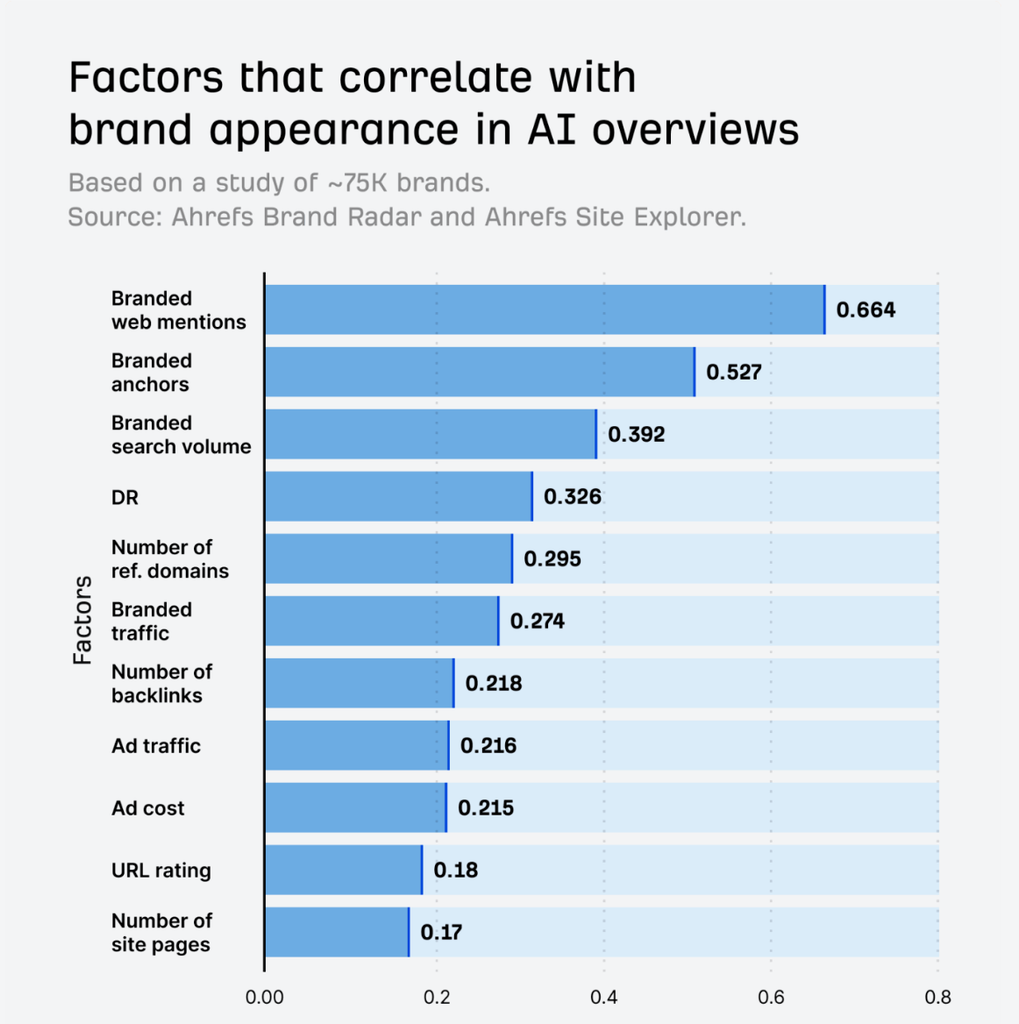
Source: Ahrefs
Improve Your Search Visibility With High-Quality Backlinks
All in all, don’t just make your website rank. Make it the name people repeatedly encounter when they seek a solution in your category.
That’s why measure where, how often, and in what context your brand appears. Besides, monitor whether that visibility contributes to your business growth.
While rankings are important, they don’t define your visibility as a whole.
So, if you want to build better brand exposure online, make sure your business is visible across platforms. And if you don’t know where to start, book a call with Building Backlinks. This way, you can start building links that can significantly strengthen your brand’s visibility and authority.
Frequently Asked Questions
1) How can I track whether people are searching specifically for my brand?
This depends on what channels you want to track. If you’re interested in Google traffic, you can check your branded search queries in any SEO tool you prefer or Google Search Console. If you want to track how often people search for your business in LLMs, you can use SEO tools that support this or specific AI visibility trackers. If you’re more interested in social media searches, go for social listening tools. But of course, it’s generally better to combine all channels.
2) What is the difference between brand awareness and brand visibility?
Brand awareness and brand visibility are two intertwined things that are still different. Brand awareness means how many people actually know that your business exists and what it does. And brand visibility is how often your business appears in front of people, typically your target audience. Often, more brand visibility leads to better brand awareness.
3) What is AI brand visibility?
It is exactly what it sounds like: how visible your business is in AI search. This typically refers to broad visibility across different LLMs, AI Overviews, and other AI features in search engines. While it’s hard to measure this properly, it’s usually tracked by how often your brand is recommended and cited in relevant topics.
4) How can social media and online mentions help measure search visibility?
If people talk about you online (including social media), it typically means two things. One, they already know your brand. And two, there is something they want to share, something interesting about your business. That’s why it’s useful to track whether people mention you online. If those mentions go up, it often means you’re doing something right.