
 ChatGPT
AI Mode
ChatGPT
AI Mode
 Claude
Perplexity
Grok
Claude
Perplexity
Grok
Last Updated on April 29, 2026 by Henry

Table of Contents
Almost every ecommerce founder faces a frustrating moment. Your store looks great. Your products are solid. Pages load fast. Everything feels right. Yet, when you search for your own category, your brand is nowhere near the top.
Then you notice something strange. A competitor with a less impressive store is ranking above you. Not by chance, not by luck, but because search engines trust them more. That trust is built through backlinks.
Backlinks are not just another SEO tactic you can put off. In ecommerce, they often decide who gets seen and who gets ignored. In fact, 65 percent of digital marketers say link building is the most difficult part of SEO, based on a survey of 518 SEO professionals. That says a lot about how competitive and complex this space really is.
But once you understand how it works, things start to shift.
This guide breaks it down in a way that actually makes sense. You will learn how to spot gaps in your current strategy, create pages people genuinely want to link to, and build momentum that keeps working in the background. Not guesswork, not shortcuts, but a system you can rely on as your store grows.
Overview of Ecommerce Link Building
Ecommerce link building is less about links and more about trust that travels. When another website points to your product pages, categories, or content, it is quietly putting its name behind yours. To Google, those signals act like proof that your store is worth noticing.
And in 2026, that proof carries serious weight. With recent core updates, off-page signals play a bigger role than ever, especially in high-intent searches where every spot on page one can directly translate into revenue.
🛒 What Is Ecommerce Link Building?
Ecommerce link building is the process of earning backlinks from other websites to your category pages, product listings, and supporting content. It is how your store gets noticed beyond its own walls.
But it does not work the same way as general link building. What earns a link for a blog post might fall flat for a product page.
In ecommerce, the real skill lies in matching the right type of link to the right page so it actually drives rankings and results.
Why Backlinks Matter for Ecommerce Stores
When a credible site links to your category page, it is more than just a mention. It is a quiet endorsement that search engines take seriously. For your store, that single signal can decide whether you show up for searches like “best standing desk under $500” or stay buried where no one looks.
The real challenge is this. Most product pages do not give you much to work with. There are only so many ways to describe a product, which makes them tough to pitch for links.
That is why smarter ecommerce brands shift the focus. They build content that people actually want to reference, then guide that authority toward their sales pages through internal linking.
It is also important to play this game carefully. Reciprocal links can happen naturally, and that is fine, but forcing them just for rankings can do more harm than good.
Audit Your Ecommerce Link Profile
Before you chase new links, pause and look at what is already pointing to your store. Most ecommerce sites carry a history of backlinks that they never really tracked. Some strengthen your presence, others quietly drag it down. If you ignore this, you end up building on something unstable.
Start with a full audit, so you know exactly where you stand. Pull all backlinks to your root domain using tools like Ahrefs Site Explorer or Semrush Backlink Analytics, then work through them with intent:
- Export all backlinks to your root domain and sort them by domain rating
- Identify links that feel out of place, such as link farms or irrelevant foreign language sites
- Map each backlink to its destination page, whether it is your homepage, category, product, or blog
- Find unlinked brand mentions through Ahrefs Content Explorer and reach out with a short, direct link request
- Submit a disavow file in Google Search Console for links you are certain are harmful
The brand mention step is often overlooked, but it is where the simplest wins live. If someone has already written about your store, the introduction is already made. All that is left is turning that mention into a link, which is far easier than starting from scratch.
Link Placement by Page Type
Not every page on your store earns attention in the same way, and treating them like they do is where most efforts fall apart. Many ecommerce brands push their product pages into outreach, hoping for links that rarely come because those pages simply are not built to attract them.
The smarter approach is more selective. Different pages play different roles, and your link building strategy needs to reflect that. It starts with understanding which pages actually influence rankings and revenue, then focusing your efforts where they can make a real difference.
📂 Why Category Pages Win the Most Links
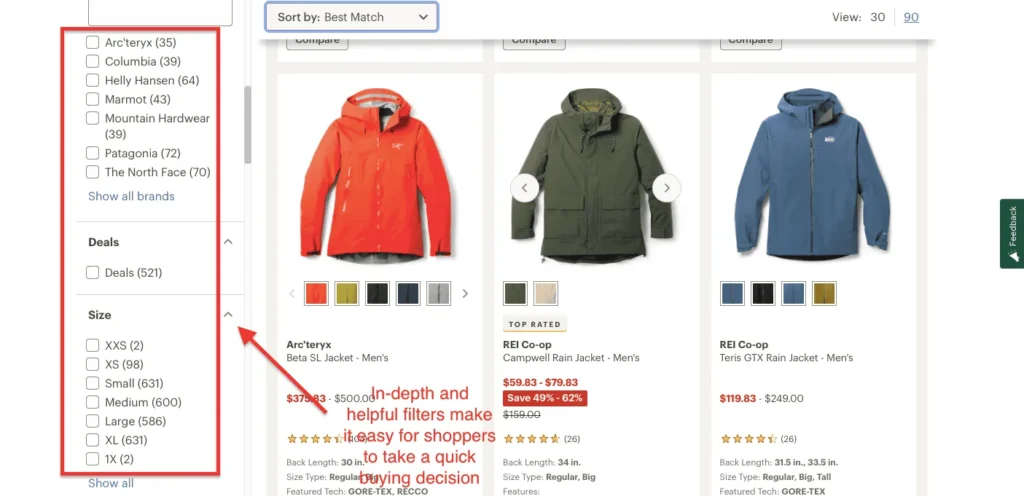
Category pages sit at the sweet spot between search intent and content depth. They target broader, high-volume keywords while giving you enough space to add meaningful content — making them far easier for other sites to reference and link to.
And the impact does not stop there. One strong backlink to a category page can strengthen every product page beneath it by passing authority through your internal links.
This means a single high-quality link can lift the pages that actually drive revenue — not just rankings.
Which Pages Should Get the Most Links
If every page on your store asks for attention, you end up spreading your efforts too thin. The real advantage comes from knowing where a single link can create a ripple effect.
Some pages attract links naturally, some need a push, and a few quietly amplify everything else behind the scenes.
Here is how that balance typically plays out:
| Page Type | Best Link Source | Primary Goal |
| Category page | Editorial guides, resource roundups | Broad keyword authority |
| Product page | Product roundups, review articles | Transactional ranking signals |
| Blog/resource | Data citations, journalist coverage | Linkable asset foundation |
| Homepage | Brand mentions, press coverage | Domain-level authority |
Category pages deserve the spotlight. They sit at the center of your store’s structure, which means every strong link here does more than boost one page. It quietly lifts the entire set of products connected to it. This is why they fit so naturally into “best of” lists and curated guides. They offer context, not just a single item.
Product pages, on the other hand, need a more deliberate approach. They are rarely linked magnets on their own, so you have to place them where intent already exists. Roundups, niche review articles, and journalist platforms become your entry points. One credible mention in the right place can outweigh a stack of weaker links that never really move the needle.
Blog and resource pages are where momentum builds. These are the pages people actually want to reference, share, and cite. When your internal linking is structured well, every link they earn flows back into your commercial pages, strengthening them without direct outreach. It is exactly how financial sites earn authority on competitive queries where trust signals matter most.
Even your homepage plays its part. It gathers brand-level trust through mentions and coverage, which then supports everything else on your domain. This layered approach is what allows strong ecommerce sites to compete in spaces where visibility and trust are hard won.
Linkable Assets for Ecommerce Sites
If your entire strategy revolves around pushing links to product and category pages, it will feel like an uphill battle. Those pages are built to convert, not to attract attention, and most publishers are not eager to link to something that reads like a sales pitch.
What they do link to is something useful, something worth referencing. That is where linkable assets step in.
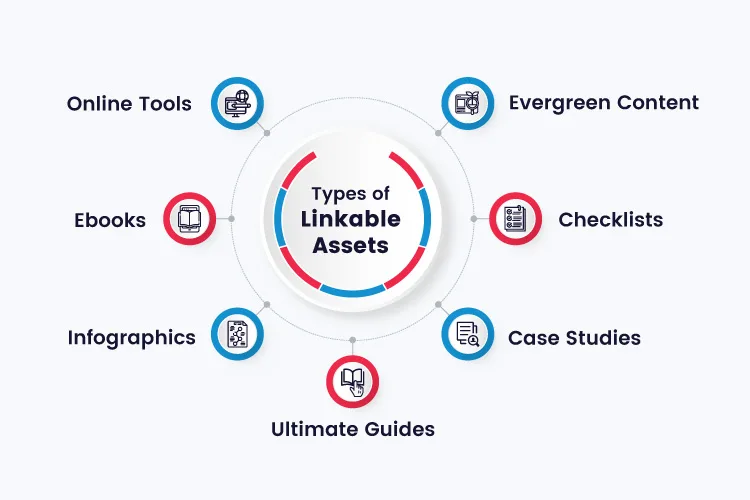
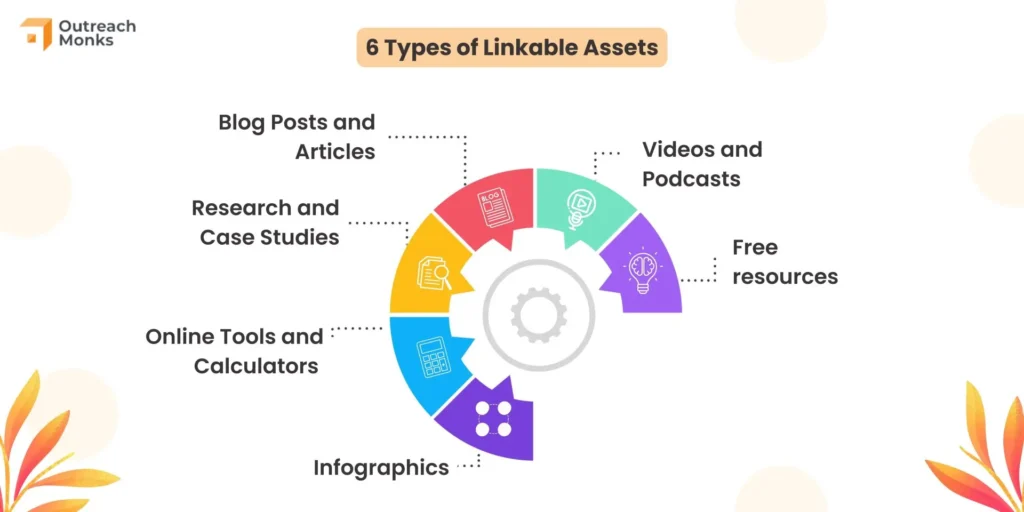
A linkable asset is any page on your site that naturally earns attention. Think original research, in-depth guides, interactive tools, or well-structured statistics pages. Create one asset that genuinely stands out, and it starts pulling in links on its own.
Over time, that single page can feed authority into your commercial pages through internal linking, working quietly in the background while your store keeps selling.
What Makes Content Naturally Attract Links
There is a simple pattern behind most backlinks. Journalists, bloggers, and researchers link to content that saves them time and strengthens what they are already writing. If your page does that well, the link almost takes care of itself. For ecommerce sites, a few formats tend to stand out again and again:
- Original data pages: Think beyond basic content and create something only you can offer. A price index, a customer survey, or a trend report gives people a reason to cite you. When the data is unique, the link becomes inevitable because there is nowhere else to point.
- Comprehensive buying guides: A detailed guide like “how to choose a standing desk” answers questions your product page never could. It attracts bloggers, niche publishers, and industry sites that want to recommend something useful without sounding promotional.
- Interactive tools: Calculators, comparison tools, or estimators turn your site into something people return to. These assets do not just earn one link; they keep getting referenced over time because they continue to be useful.
The real shift happens in how you launch these assets. Do not wait until after publishing to think about promotion. Build a focused outreach list in advance, ideally 50 to 100 relevant publications, so your content gets early traction. Those first few links send a strong signal that the page matters.
Some SEOs also use atiered link building approach here, building links to the asset first, then letting that authority flow through to commercial pages, which can accelerate results when done cleanly.
Effective Link Building Techniques
Now we get to the part that actually moves things forward. Not every tactic delivers the same results, and chasing every new trick usually leads nowhere.
For ecommerce sites, a handful of approaches consistently stand out because they tap into how people naturally link.
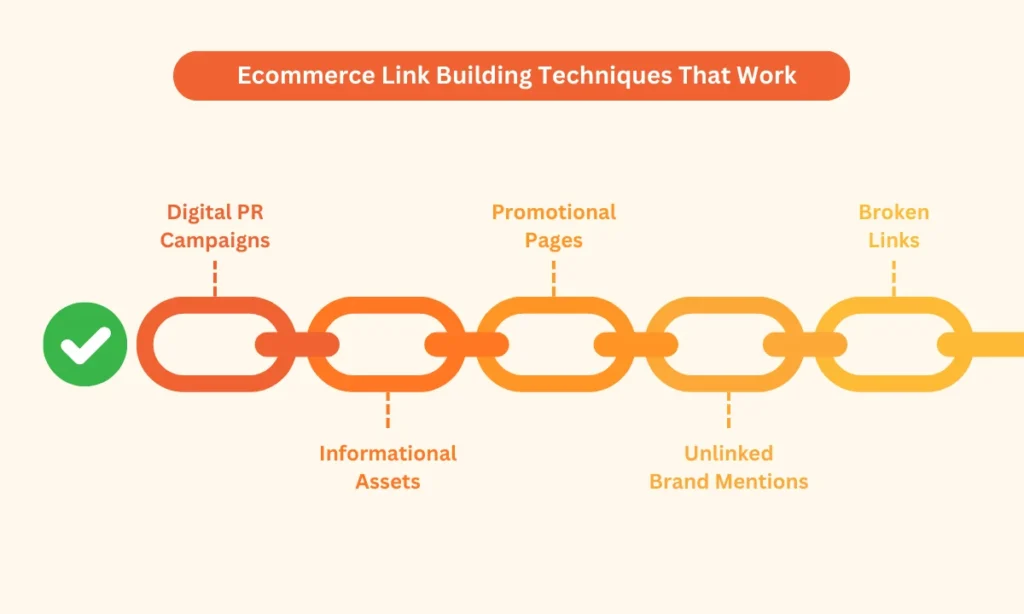
Broken link building, guest posting, digital PR, and unlinked brand mentions each open a different door. Some help you step into existing content, some put your brand in front of new audiences, and others turn missed opportunities into easy wins.
The real advantage comes from using them together, not in isolation, so your link profile grows with depth instead of randomness.
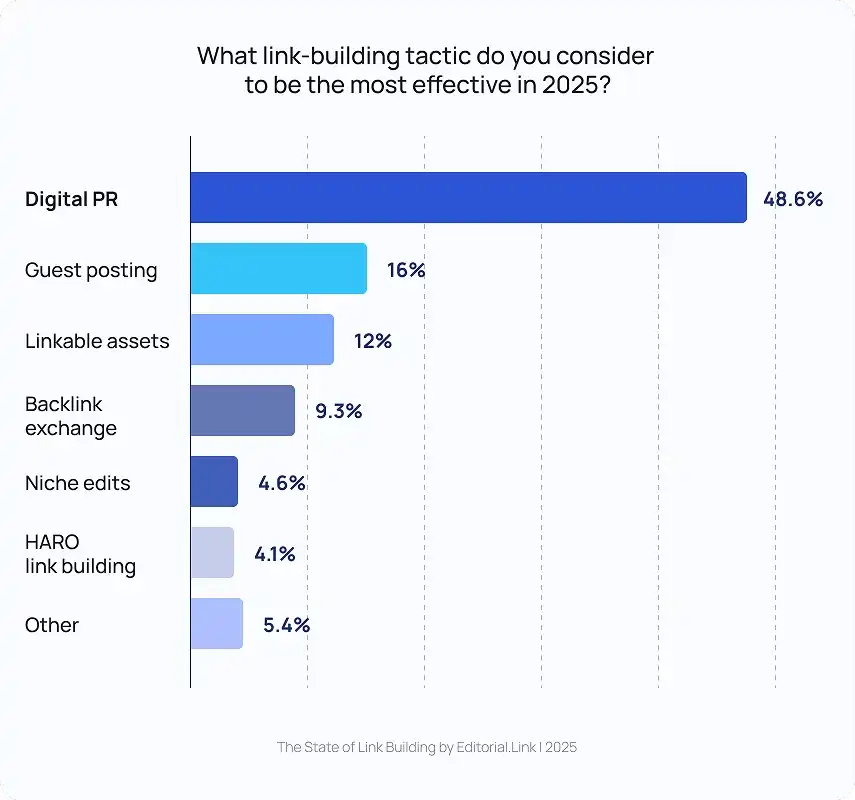
⚡ Quick Stat: Digital PR Leads All Link Building Tactics
If one tactic has quietly taken the lead, it is digital PR. Around 67% of marketers now rely on it as their primary way to earn links, making it the most widely used approach today.
The reason is simple. It does not feel like link building at all. Instead of asking for links, you create stories, insights, or data that publishers actually want to cover.
The backlinks come as a byproduct of that visibility — not as a request.
That is what makes it powerful. These are true editorial links, earned naturally and at scale, making them one of the strongest trust signals you can send to Google.
Broken Link Building for Ecommerce
This tactic flies under the radar, and that is exactly what makes it so effective. Instead of chasing new opportunities from scratch, you step into gaps that already exist. A broken link is a problem for a site owner, and if you can fix it with something better, the exchange feels natural.
Here is how to approach it without overcomplicating the process:
- Open Ahrefs Site Explorer and run a broken backlinks report on a few competing domains
- Look for broken pages that were linked by multiple sites, since that signals proven demand
- Create a resource on the same topic, but make it more useful, clearer, or more up-to-date
- Reach out with a short email that points out the broken link and offers your page as a replacement
When done well, this does not feel like outreach. It feels like a helpful nudge. That is why it works. Response rates usually fall between 4 and 15 percent, depending on how closely your content matches the original and how relevant your pitch is.
Send enough well-targeted emails, and it turns into a steady, predictable source of backlinks.
Guest Posts and Link Inserts
Guest posting is straightforward. You write something valuable for another site, and in return, earn a contextual link back. The key is relevance. A site with a real audience in your niche will always outperform one that only looks strong on metrics.
When vetting sites, look beyond domain rating. Aim for DR 50+, at least 5,000 monthly visits, and clear editorial guidelines. And when you pitch, be specific. A tailored idea gets attention, a generic one gets ignored.
If creating a full post feels like too much, link inserts are a faster option. You place your link into an existing article where it fits naturally. Fewer approvals, but quicker wins.
In competitive niches, this becomes even more useful. For example, in law firm SEO, where guest posting is tough, link inserts into existing legal resources are often the more practical route.
Digital PR and Creative Campaigns
Digital PR is the highest-ceiling tactic on this list. Instead of pitching a link, you pitch a story: original data, a trend report, a consumer behavior survey, and you let journalists link to you naturally when they cover it. No ask required.
Find a data angle your industry does not have yet and pitch it to trade publications, lifestyle blogs, and news outlets that cover your niche.A study of 500 campaigns found the average digital PR campaign earns links from 42 unique referring domains, with early placements landing within 30 days of outreach.
Track every placement in Ahrefs, so you know your cost per acquired link and can double down on the angles that land.
Paid Links and Risky Tactics to Avoid
This is where shortcuts start to look tempting. A cheap PBN package, a paid review slipped in without disclosure, it all feels harmless in the moment. Until it is not.
Google’s spam policies are very clear about this. When you cross that line, the impact is rarely small. A manual action does not just hit a page; it can drag down your entire domain and wipe out visibility overnight.
What looks like a quick win often turns into a long recovery.
⚠️ Google’s Rule on Paid Links
If a link is exchanged for money, products, or services, it must be clearly disclosed. This is where the rel=”sponsored” attribute comes in.
Paid reviews, affiliate mentions, and advertorials all fall under this rule. These links are not meant to pass ranking authority unless properly tagged.
Skipping the tag does not make the link blend in — it simply puts you on the wrong side of Google’s guidelines.
And once that line is crossed, the risk is not limited to a single page. It can put your entire domain under scrutiny.
Here is what to stay away from entirely:
Some tactics promise fast results, but they leave footprints that are hard to hide and even harder to recover from. It is not just about avoiding penalties; it is about protecting the long-term credibility of your store.
- Private blog networks (PBNs): These are built only to pass authority, not to provide value, and Google has become very good at spotting them
- Sitewide footer or sidebar links: When your link appears across an entire site, it looks forced rather than earned
- Redirecting expired domains: Buying old domains and pointing them to your store may seem clever, but it is a well-known signal that often triggers manual review
- Link exchanges: Swapping links without real context might work briefly, but at scale, it crosses into manipulation
- Over-optimized anchor text: If too many links repeat the same keyword-heavy phrase, it creates a pattern that is easy for search engines to flag
Keep your growth steady and believable. Around ten to thirty new referring domains each month tends to look natural. If you notice sudden spikes, take a closer look at your anchors and link sources before it turns into a problem.
Measure and Report Link Building Results
Link building rarely shows instant results, and watching rankings every day can be frustrating. The smarter way to track progress is by focusing on early signals that point to future growth. When those start moving, rankings usually follow.
Instead of relying on a single tool, look at the full picture. Google Search Console shows how your traffic is shifting, while tools like Ahrefs or Semrush reveal what is happening behind the scenes with your backlinks. Together, they tell a more complete story.
This same reporting discipline applies whether you are running an ecommerce store or managing real estate backlinks for property listings, where tracking domain-level authority gains is equally critical.
A simple monthly check can keep you on track:
- New referring domains added, aiming for consistent growth over time
- Changes in domain rating or authority score
- Organic traffic trends on pages targeted by your link efforts
- Lost referring domains, especially if the drop feels sharp
- Any unusual rise in spam signals that needs attention
The pattern to watch is simple. When a category page starts picking up a few strong backlinks and rankings begin to climb within a couple of months, you have found something that works.
The next step is not to reinvent it, but to repeat it. Most professionals see this kind of impact within one to six months, which makes consistency far more valuable than chasing quick wins.
Get Professional Backlinks for ECommerce 🚀
Link building for ecommerce is not about chasing links. It is about earning attention in the right places and letting that attention compound over time. The stores that win are not the ones doing everything; they are the ones doing a few things consistently well.
When you focus on pages that actually matter, create content worth referencing, and build links that feel natural, the results stop feeling random. They start to follow a pattern. Visibility grows, authority strengthens, and rankings begin to move with purpose.
There is no single tactic that changes everything overnight. But there is a system that works quietly in the background, strengthening your store day by day. Build that system, stay consistent, and your growth will not need shortcuts to show up.
Frequently Asked Questions
1) How Do You Build Backlinks For An Ecommerce Site?
Start by auditing competitor backlinks in Ahrefs to find proven link sources, then build a linkable asset like a data study, buying guide, or tool, and earn placements through broken link outreach, guest posts, and digital PR.
2) What Pages Should Get Backlinks 0n An Ecommerce Site?
Prioritize category pages for broad keyword authority, product pages for transactional signals, and blog pages as your link-earning engine. Homepage links build brand authority but should not be your only target.
3) How Long Does Ecommerce Link Building Take?
Expect three to six months before referring domain growth translates to ranking movement. Track domain-level metrics monthly rather than checking keyword positions daily.
4) Are Paid Links Safe For Ecommerce Sites?
No. Undisclosed paid links violate Google’s spam policies and can trigger a manual action. Paid links need a rel=”sponsored” tag per Google’s guidelines. The risk is never worth the short-term gain.